


_______________________________
_______________________________
This is a pdf of the English translation of the Diwans of the Darqawi Shaykhs, Muhammad ibn al-Habib, Muhammad al-Fayturi, Muhammad al-Harraq and Mustafa al-‘Alawi, may Allah bless them all and grant us benefit by their work.
This is placed here as a resource for the Fuqara, in response to requests for the English translations of these greats men’s songs. As far as I know this is very hard to find and is out of print and is the only copy I have.
Please click on the link below and then on the first instance of its repetition on the succeeding page:
___________________
Ash-Shafi’u
The existence of intercession by the intercessor is essential to the Muslim. Intercession is a gift from Allah to both His Prophet and the Prophet’s ummah or people.
It is a gift to the Rasul, sallallahu alayhi wa sallim, because of his love for his people and a gift to them because of their need and the inherent weakness of humanity. Continue reading “The Intercessor”
Thanks to: Shaykh Mawlay Murtada for his permission and checking the typesetting and to Hajj Abdassamad Clarke for the typesetting.
Note: The closest tunes that I can find in the Diwan of Shaykh Muhammad ibn al-Habib are; ‘Kana li wahmun’, ‘Ya man yurid hadratal ‘iyani’, ‘Ruhi tuhadithuni’. Any other suggestions for tunes you have, please let us know.
____________________________

___________________________
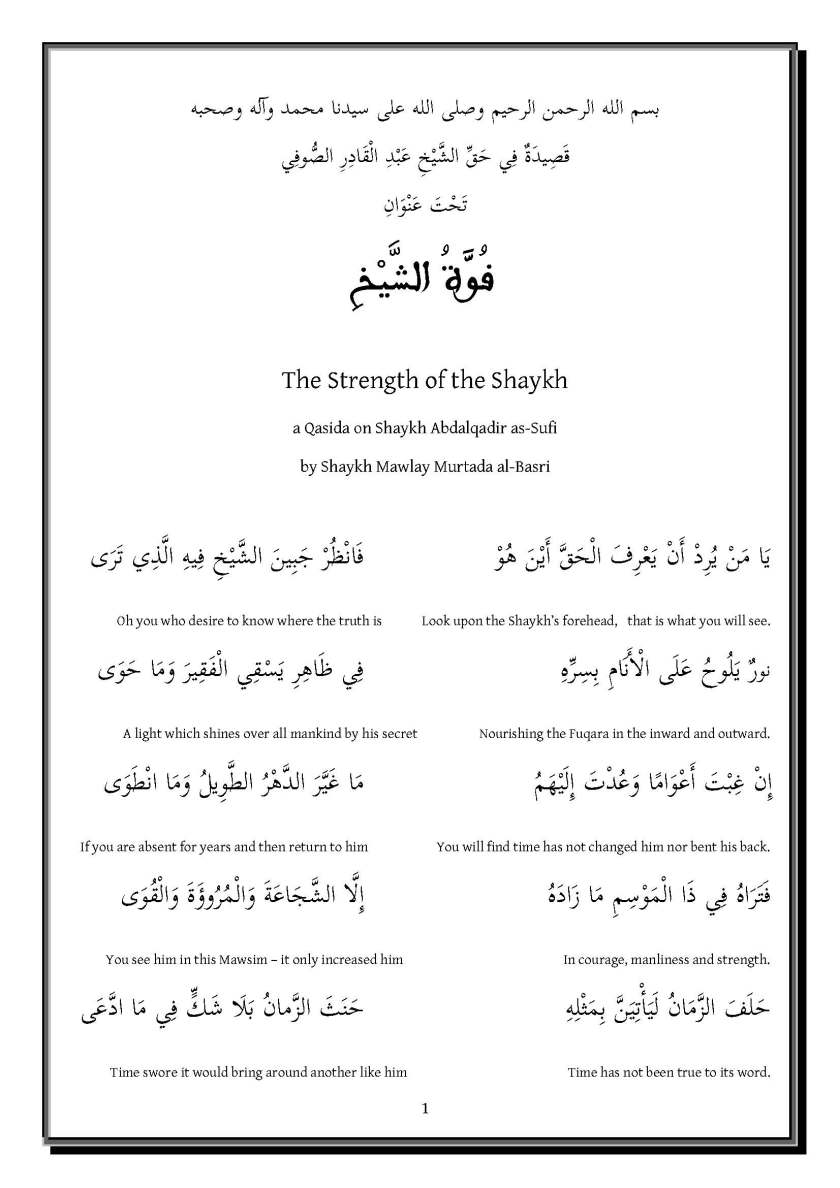
Oh you who desire to know where the truth is
Look upon the Shaykh’s forehead, that is what you will see.
A light which shines over all mankind by his secret
Nourishing the Fuqara in the inward and outward.
If you are absent for years and then return to him
You will find time has not changed him nor bent his back.
You see him in this Mawsim – it only increased him
In courage, manliness and strength.
Time swore it would bring around another like him –
Time has not been true to its word.
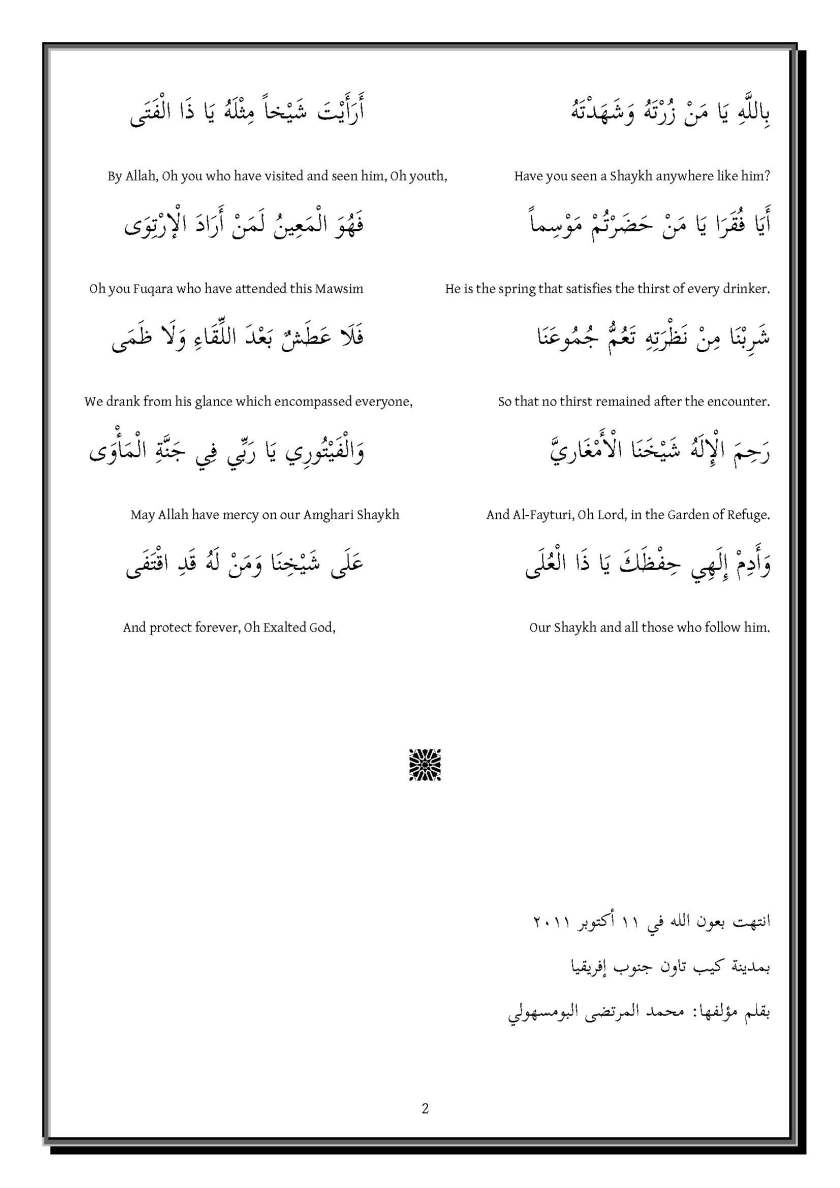
By Allah, Oh you who have visited and seen him, Oh youth,
Have you seen a Shaykh anywhere like him?
Oh you Fuqara who have attended this Mawsim
He is the spring that satisfies the thirst of every drinker.
We drank from his glance which encompassed everyone,
So that no thirst remained after the encounter.
May Allah have mercy on our Amghari Shaykh
And Al-Fayturi, Oh Lord, in the Garden of Refuge.
And protect for ever, Oh Exalted God,
Our Shaykh and all those who follow him.
_______________________________

There is a connection between Iman and Fitr. The Rasulullah, sallallahu alayhi wa sallim, indicated in the renown hadith that Fitr was a naturalness of being; a being uncontaminated by influence, initially inherent in all humans, a reverberation of “Alastu birabbikum”. Continue reading “Ῑmān and Fiṭr”
Allah, subhanahu wa ta’ala, ties Iman (trust) and ‘Aml (work) together throughout the blessed and noble Book, but ‘Aml, is always qualified by the word ‘Salih’. These two words are completely unambiguous, ‘Aml being action or work and Salih meaning good, incorrupt, honest, virtuous, sound and in good order. Iman and ‘Amilu Salihat translate directly into the two pillars of Salah and Zakah as the foundation of the life of the Muslim and from them all good proceeds. It is as if, without this manifestation, the spring of life remains hidden within the mountain and does not burst forth and flow with its life-giving nourishment. This bi-directional existence of the Muslim, one exclusively to his Lord, the other to his fellow man marks him out among the generality and he becomes a locus of sincerity, worshipping his Master because it is His due and working for his nation because it is their due.
Continue reading “‘Aml”

One of the great victims of the modern era of calculation and valuation is imagination. In the reduction of values to the numerical, i.e. popularity, Van Gogh = $23,000,000, and so on, the possible has been reduced to the probable.
The possible is only limited by Allah, subhanahu wa ta’ala, and the probable, for man, is what he limits himself to.
I remember our shaykh, Dr. Abdalqadir as-Sufi telling us once that, Continue reading “Imagine”
The reason for it is that the self in its natural state of creation is ready to accept whatever good or evil may arrive and leave an imprint upon it. Muhammad, sallallahu alayhi wa sallim, said:
“Every infant is born in the natural state, Fitrah. It is his parents who make him a Jew or a Christian or a Magian.”
To the degree the self is first affected by one of the two qualities, it moves away from the other and finds it difficult to acquire it. When customs proper to goodness have been first to enter the self of a good person and has thus acquired the habit of (goodness, that person) moves away from evil and finds it difficult to do anything evil. The same applies to the evil person when customs (proper to evil) have been first to affect him. Continue reading “From the Muqaddimah of ibn Khaldun – with a note”

First Khutbah
Friday 29 October 1999
Everyday, many times a day all Muslims turn to Allah and say, ba’d audhu billahi minash shaytanir rajim;
Ihdinas siratal mustaqim
Guide us on the Straight Path.
Sadaqa’llahul ‘Adhim
We are told by the Mufassireen, the recognised commentators on the Noble Qur’an, that the Surat al-Fatihah from which this blessed ayah comes contains all of the Qur’an. They say this means it contains all the various elements that are expanded upon throughout Allah’s Book, such as the Oneness of Allah, the Shari’ah, stories of the Prophets, the Next world and so on.
The Sirat al-Mustaqeem is considered as that part of our journey lived in this world according to what Allah and His Rasul, sallallahu alayhi wa sallim, laid down as correct and without fault, leading to the Garden in the Next World. Its being the path through this world is emphasised by our request of Allah that precedes it in this ayah, namely – ihdina – guide us. Continue reading “Knowledge and Governance”
 Shaykh Issa - for the Fuqara